
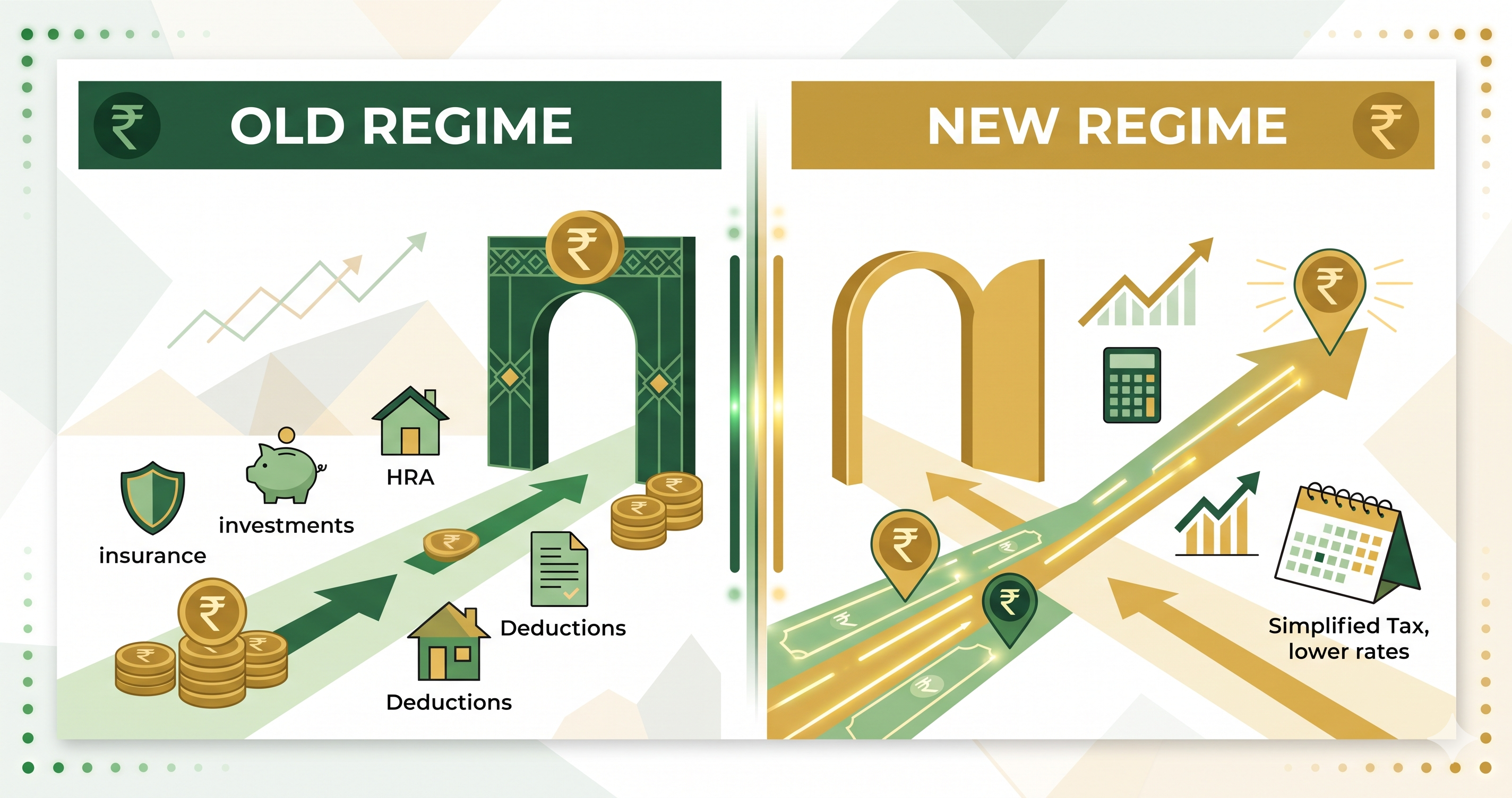
Every year, millions of Indian taxpayers face the same question: old regime or new regime? And every year, most people either guess, copy what their colleague did, or just go with whatever their company has set as default.
That is a costly mistake. The wrong choice can mean paying thousands of rupees more in tax than you need to.
This guide breaks down both regimes clearly — the slabs, the deductions, who benefits from each, and a simple way to decide which one is right for you in FY 2025-26.
What Changed in FY 2025-26?
Before we compare, here is the big news from Budget 2025 that changed the calculation for most taxpayers:
The government made the new tax regime significantly more attractive by raising the Section 87A rebate limit. As a result, income up to ₹12 lakh is now effectively tax-free under the new regime (₹12.75 lakh for salaried individuals after the ₹75,000 standard deduction). This is a massive jump from the earlier ₹7 lakh limit in FY 2024-25.
This single change means that for a large section of Indian taxpayers — particularly those earning below ₹12–15 lakh — the new regime now wins by default. But not for everyone. Let us understand why.
The Two Tax Regimes at a Glance
India’s income tax system currently offers two parallel structures. You choose one each year when filing your ITR (if you are a salaried individual or have non-business income).
Old Tax Regime: Higher tax rates, but allows a wide range of deductions and exemptions — 80C, 80D, HRA, home loan interest, LTA, and more. The more deductions you claim, the lower your taxable income and hence your tax.
New Tax Regime (Default since FY 2023-24): Lower tax rates across the board, but most deductions are not allowed. What you earn is largely what gets taxed, minus a few limited exceptions.
Tax Slabs: Old Regime vs New Regime (FY 2025-26)
New Tax Regime Slabs (FY 2025-26)
| Income Slab | Tax Rate |
|---|---|
| Up to ₹4 lakh | Nil |
| ₹4 lakh – ₹8 lakh | 5% |
| ₹8 lakh – ₹12 lakh | 10% |
| ₹12 lakh – ₹16 lakh | 15% |
| ₹16 lakh – ₹20 lakh | 20% |
| ₹20 lakh – ₹24 lakh | 25% |
| Above ₹24 lakh | 30% |
Important: A Section 87A rebate makes income up to ₹12 lakh effectively tax-free. Salaried individuals also get a ₹75,000 standard deduction, making ₹12.75 lakh effectively tax-free.
Old Tax Regime Slabs (FY 2025-26)
| Income Slab | Tax Rate |
|---|---|
| Up to ₹2.5 lakh | Nil |
| ₹2.5 lakh – ₹5 lakh | 5% |
| ₹5 lakh – ₹10 lakh | 20% |
| Above ₹10 lakh | 30% |
Senior citizens (60–80 years) get a basic exemption of ₹3 lakh; super senior citizens (80+) get ₹5 lakh under the old regime.
Add 4% Health and Education Cess on your final tax liability under both regimes.
What Deductions Are Allowed Under Each Regime?
This is where the real difference lies.
Old Regime — Deductions Available
| Deduction | Limit |
|---|---|
| Section 80C (PPF, ELSS, EPF, LIC etc.) | Up to ₹1.5 lakh |
| Section 80D (health insurance) | ₹25,000 self + ₹25,000/₹50,000 parents |
| HRA exemption | Based on salary and rent paid |
| Home loan interest (Section 24b) | Up to ₹2 lakh (self-occupied) |
| Standard deduction | ₹50,000 |
| LTA exemption | Actual travel cost (twice in 4 years) |
| NPS deduction (80CCD 1B) | Additional ₹50,000 |
| Home loan principal (80C) | Included in 80C limit |
New Regime — Deductions Allowed
| Deduction | Limit |
|---|---|
| Standard deduction | ₹75,000 |
| Employer NPS contribution (80CCD 2) | Up to 14% of basic salary |
| Home loan interest on let-out property | Actual interest (no cap) |
| Agniveer Corpus Fund (80CCH) | Full amount |
Everything else — 80C, 80D, HRA, LTA, home loan interest on self-occupied property — is not available under the new regime.
Who Should Choose the New Regime?
The new regime works well for you if:
1. Your income is below ₹12.75 lakh (salaried) Thanks to the rebate and standard deduction, your tax liability is zero. There is nothing to optimise.
2. You have minimal investments and deductions If you are not investing much in PPF, ELSS, or insurance, the old regime offers little advantage. The new regime’s lower rates will serve you better.
3. You are young and just starting out Early in your career, you may not have a home loan, large insurance premiums, or built-up 80C investments. The new regime keeps things simple and your take-home higher.
4. You want simplicity No tracking receipts, no investment proofs, no HRA declarations. File your ITR in minutes.
5. Your employer’s NPS contribution is high This deduction under 80CCD(2) is allowed in the new regime and can be substantial — up to 14% of your basic salary. Factor this in before deciding.
Who Should Choose the Old Regime?
The old regime makes more sense if:
1. You have a home loan on a self-occupied property The interest deduction of up to ₹2 lakh per year (Section 24b) is not available in the new regime. If you are paying ₹1.5–2 lakh in home loan interest annually, the old regime can save you significant tax.
2. You are maximising 80C investments If you are consistently investing ₹1.5 lakh in PPF, ELSS, or EPF every year and also paying LIC premiums, you are already claiming the full 80C deduction. Combined with 80D and HRA, this can bring your taxable income down significantly.
3. You are paying significant rent in a metro city HRA exemption can be very large for people living in Mumbai, Delhi, Bengaluru, or Chennai and paying high rent. This is completely disallowed in the new regime.
4. Your total deductions exceed the break-even threshold As a rule of thumb: if your total deductions exceed ₹3.75 lakh (for income around ₹10–15 lakh), the old regime tends to be more beneficial. The higher your income and the higher your deductions, the stronger the case for the old regime.
A Real Example: Same Income, Two Outcomes
Let us take Rohit, a 32-year-old software engineer in Bengaluru earning ₹15 lakh per year.
Rohit’s deductions:
- 80C (ELSS + EPF): ₹1.5 lakh
- 80D (health insurance): ₹25,000
- HRA exemption: ₹1.2 lakh
- Home loan interest: ₹1.5 lakh
- Standard deduction: ₹50,000
Total deductions under old regime: ₹4.95 lakh Taxable income under old regime: ₹15L – ₹4.95L = ₹10.05 lakh Tax under old regime: approximately ₹1,17,000 + 4% cess = ₹1,21,680
Under new regime:
- Standard deduction: ₹75,000
- Taxable income: ₹15L – ₹75K = ₹14.25 lakh
- Tax as per new slabs: approximately ₹1,50,000 + 4% cess = ₹1,56,000
Result: Old regime saves Rohit approximately ₹34,000 in this case.
Now take Priya, a 27-year-old working in Pune earning ₹10 lakh. She lives with her parents, has no home loan, and invests just ₹50,000 in PPF annually.
Her total deductions under the old regime would be around ₹1 lakh. Under the new regime her income is well within the ₹12 lakh effective tax-free limit after standard deduction adjustments. Her tax liability is zero under the new regime. The old regime would cost her more.
The Break-Even Point: A Quick Reference
Here is a simplified guide to help you decide based on your income and deductions:
| Annual Income | Stick with New Regime if deductions are below | Choose Old Regime if deductions exceed |
|---|---|---|
| Up to ₹12.75 lakh | Any amount (tax is zero anyway) | N/A |
| ₹15 lakh | ₹3.5 lakh | ₹3.5 lakh |
| ₹20 lakh | ₹4.25 lakh | ₹4.25 lakh |
| ₹25 lakh | ₹5 lakh | ₹5 lakh |
| Above ₹25 lakh | ₹8 lakh | ₹8 lakh |
These are approximate break-even figures. Your actual numbers may vary depending on your income composition, HRA city, and specific deductions. Always calculate both scenarios before deciding.
Can You Switch Between Regimes Every Year?
Yes — if you are a salaried individual or have no business income.
You can choose your regime fresh each year at the time of filing your ITR. So if you claim deductions this year and go with the old regime, you can switch to the new regime next year if your circumstances change.
Exception: If you have income from business or profession, you can only switch once. After switching out of the new regime, you cannot go back. Choose carefully.
How to Declare Your Regime to Your Employer
Your employer deducts TDS on your salary based on the regime you declare at the start of the financial year. If you do not declare anything, your employer will default to the new regime from FY 2023-24 onwards.
To declare the old regime, submit a written declaration or fill out your employer’s investment declaration form (usually in April) and choose the old regime explicitly. You can change this declaration during the year, but it gets complicated. It is best to decide early.
Note that even if your employer deducts TDS under one regime, you can choose the other regime when filing your ITR — but you will need to pay any additional tax due (or claim a refund if you overpaid).
The Bottom Line
Here is the simplest way to think about it:
- Earning below ₹12.75 lakh (salaried)? → New regime. Zero tax. No decision needed.
- Earning above ₹12.75 lakh with large deductions (home loan + HRA + 80C + 80D)? → Run the numbers. Old regime likely wins.
- Earning above ₹12.75 lakh with minimal deductions? → New regime. Lower rates, less paperwork.
- Not sure? → Use the Income Tax Department’s free tax calculator at incometax.gov.in to calculate your liability under both regimes before deciding.
The new regime is simpler, and for FY 2025-26 it is genuinely better for most taxpayers thanks to the ₹12 lakh rebate. But if you have a home loan, pay significant rent, or are disciplined about 80C investments, do not assume the new regime wins — do the maths first.
Disclaimer: The tax figures in this article are based on Income Tax Act 2025 provisions for FY 2025-26 (AY 2026-27). Tax laws are subject to change. Please consult a qualified chartered accountant for personalised advice before making your tax filing decisions.