
In the Indian financial landscape of 2026, the Income Tax Return (ITR) is far more than just a tax-filing exercise; it is your primary financial identity document. Whether you are a salaried employee, a business owner, or an investor, understanding your filing obligations is essential to avoid penalties and leverage the full scope of financial benefits.
With the introduction of the Income Tax Bill 2026, the compliance framework has evolved to integrate global standards while simplifying the process for small taxpayers. Below is the definitive guide on who must file an ITR this season.
1. The Threshold-Based Mandatory Filing
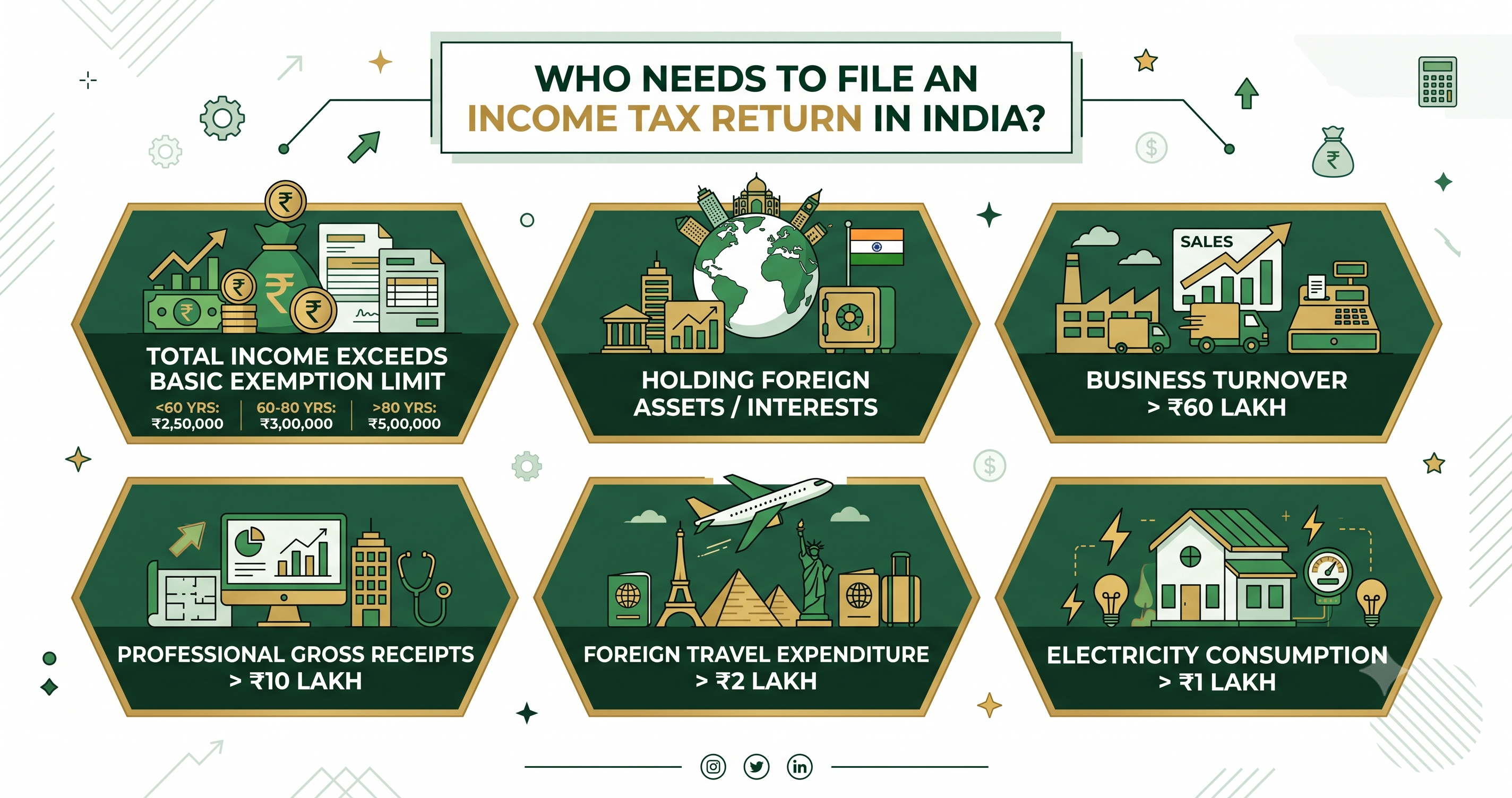
The most common trigger for filing an ITR is your total annual income. If your gross total income exceeds the Basic Exemption Limit, filing is mandatory. As of FY 2025-26, these limits are:
- New Tax Regime: Income above ₹4 lakh per annum.
- Old Tax Regime: Income above ₹2.5 lakh per annum (for individuals below 60 years).
Note for Senior Citizens:
- Citizens aged 60–80: Exemption limit is ₹3 lakh (under the old regime).
- Super Senior Citizens (80+): Exemption limit is ₹5 lakh (under the old regime).
2. Mandatory Filing: When Income is Below the Threshold
The Income Tax Department has expanded the “Seventh Proviso” to Section 139(1), making ITR filing mandatory for certain individuals even if their income is below the exemption limit. You must file if you meet any of the following criteria:
- Bank Deposits: You have deposited an aggregate of more than ₹1 crore in one or more current accounts.
- Savings Account: You have deposited more than ₹50 lakh in one or more savings bank accounts.
- Foreign Travel: You have spent more than ₹2 lakh on foreign travel for yourself or any other person.
- Electricity Consumption: Your annual expenditure on electricity exceeds ₹1 lakh.
- High-Value TDS/TCS: The aggregate of Tax Deducted at Source (TDS) and Tax Collected at Source (TCS) during the financial year is ₹25,000 or more (₹50,000 for senior citizens).
- Business/Professional Turnover: Your business turnover exceeds ₹60 lakh or your professional receipts exceed ₹10 lakh.
3. Mandatory Categories (Regardless of Income)
Certain entities must file a return every year, regardless of whether they earned a profit or incurred a loss:
- Private Limited Companies: All registered companies under the Companies Act must file ITR-6.
- LLPs: Limited Liability Partnerships must file ITR-5.
- Loss-Making Businesses: If you wish to carry forward business or capital losses to offset future profits, filing the ITR before the due date is mandatory.
- NRIs: Non-Resident Indians earning income in India (via salary, capital gains, or rental income) are subject to the same exemption thresholds as residents.
4. Why You Should File Even if You Aren’t Obliged
Filing voluntarily – even when not strictly required – is a strategic move for several reasons:
- Loan Approvals: Lenders (banks and NBFCs) rely on ITR copies as the gold standard for verifying income when processing home, business, or personal loans.
- Visa Processing: Many foreign embassies require 2 – 3 years of ITR filings as proof of financial stability.
- Refunds: If your TDS was deducted in excess of your actual tax liability, filing an ITR is the only way to claim that money back from the government.
- Credit Credibility: Consistent ITR filings help build a solid financial profile, which can be beneficial for high-value credit card approvals or institutional memberships.
5. Quick Reference: Choosing Your ITR Form
Selecting the wrong form is the leading cause of return rejection. Match your profile to the correct form:
| Form | Eligibility |
| ITR-1 (Sahaj) | Resident individuals with salary/pension, one/two house properties, and other income up to ₹50 lakh. |
| ITR-2 | Individuals/HUFs not having business/professional income (includes capital gains, foreign assets). |
| ITR-3 | Individuals/HUFs with income from business or profession (not eligible for presumptive taxation). |
| ITR-4 (Sugam) | Individuals/HUFs/Firms with presumptive business/professional income (Section 44AD/44ADA/44AE). |
| ITR-5 | For LLPs, AOPs, and BOIs. |
| ITR-6 | For companies other than those claiming exemption under Section 11. |
| ITR-7 | For trusts, political parties, and institutions. |
6. The 2026 Compliance Roadmap
- Due Date (Non-Audit): Generally July 31, 2026, for individuals and small taxpayers.
- Due Date (Audit Cases): Generally October 31, 2026.
- Verification: Filing the return is only half the battle. You must e-verify your return using an Aadhaar OTP, net banking, or EVC to make it legally valid.
- AIS/Form 26AS: Before filing, always download your Annual Information Statement (AIS) and Form 26AS from the Income Tax portal to ensure that all your financial transactions – including high-value investments and dividend income – are accounted for.
Final Advice: The “Updated Return” Option
If you realize you made a mistake or missed an income source after filing, you can utilize the Updated Return (ITR-U) under Section 139(8A). This allows you to file an updated return within 24 months from the end of the relevant assessment year, albeit with a payment of additional tax.
Disclaimer: This guide is for informational purposes and reflects the 2026 tax framework. Tax laws are subject to dynamic changes; always verify your specific liability with a Chartered Accountant or a certified tax professional before submission.