
Every couple of months, a headline flashes across financial news channels: “RBI keeps repo rate unchanged at 5.25%.” For most people, it registers for about five seconds before they move on with their day. But that single number set by six people in a room in Mumbai quietly shapes your EMI, your fixed deposit returns, your mutual fund performance, and even how easily you’ll find a job next year.
This isn’t an exaggeration. Here’s exactly how RBI’s policy decisions filter down into your personal finances, and what to actually watch for.
What the RBI’s Monetary Policy Committee Actually Decides
The Reserve Bank of India’s Monetary Policy Committee (MPC) a six-member body currently chaired by Governor Sanjay Malhotra meets roughly every two months to review inflation, growth, and liquidity conditions, and decide where to set the repo rate: the rate at which RBI lends short-term funds to commercial banks.
As of the June 2026 meeting, the MPC held the repo rate steady at 5.25% for the third consecutive meeting, maintaining a “neutral” policy stance. The committee also revised its outlook cutting its FY 2026-27 GDP growth forecast to 6.6% from an earlier 6.9%, and raising its inflation forecast to 5.1%, citing pressure from elevated crude oil prices, geopolitical tensions in West Asia, and uncertainty around the monsoon. The next policy review is scheduled for 3–5 August 2026.
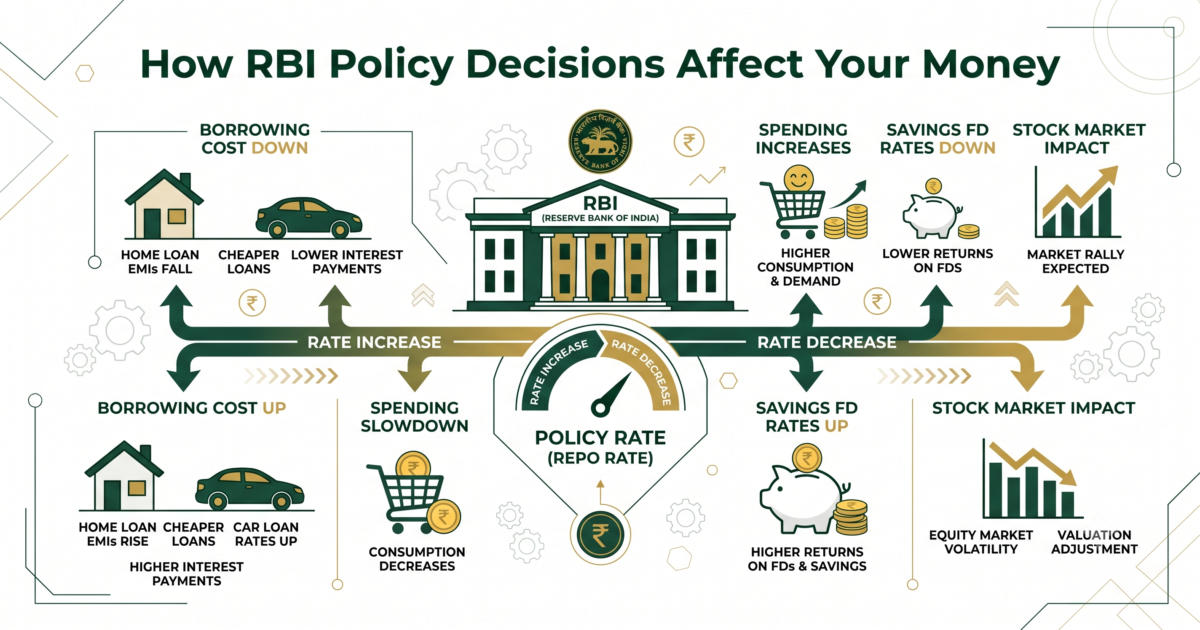
Why does a single rate matter so much? Because the repo rate is the base cost of money for the entire banking system. When it moves, everything priced off borrowed money loans, deposits, even equity valuations eventually moves with it.
How It Hits Your EMIs
This is the most direct and most-felt impact. If you have a floating-rate home loan, personal loan, or car loan, your interest rate is typically linked to the repo rate through the External Benchmark Lending Rate (EBLR) system.
- When RBI cuts the repo rate, banks lower their lending rates, and your EMI either drops or your loan tenure shortens usually within one to three months, depending on your bank’s reset cycle.
- When RBI holds or raises rates, your EMI stays the same or climbs.
With the repo rate on hold at 5.25% through 2026 so far, most floating-rate borrowers have seen stable EMIs but that stability is itself the outcome of a live policy choice, not a given. If you’re on an older MCLR-linked loan rather than a repo-linked one, transmission is slower and less direct, which is worth checking with your bank if you’re not sure which benchmark your loan follows.
Practical takeaway: If you’re planning a large loan home, car, or otherwise a rate hold or cut cycle is generally a better time to lock in than a rising-rate environment. And if your loan is still on MCLR, ask your bank about switching to a repo-linked rate; the switch is usually low-cost and gets you faster transmission in both directions.
How It Hits Your Fixed Deposits and Savings
Deposit rates move in the same direction as the repo rate, just with a lag and with banks retaining some discretion based on their own liquidity needs.
- Repo rate cuts eventually pull FD and savings account interest rates down, since banks’ own cost of funds falls and they don’t need to compete as hard for deposits.
- Repo rate holds or hikes tend to keep FD rates firmer, sometimes even pushing them up if banks are competing for deposits to fund credit growth.
If you’re a saver relying on fixed income from FDs, a prolonged low-rate or rate-cut environment quietly erodes your real returns especially once you account for inflation, which the RBI itself has projected at an elevated 5.1% for FY 2026-27. This is one of the less-discussed effects of monetary policy: it’s not just borrowers who feel it, savers absorb an opposite but equally real impact.
Practical takeaway: If the current environment is one of rate holds with inflation trending up, it’s worth locking in current FD rates for a longer tenure rather than assuming better rates are coming, and reassessing whether an all-FD strategy for your fixed-income allocation still makes sense against alternatives like debt mutual funds.
How It Hits the Stock Market
Equity markets react to repo rate decisions almost in real time, for a fairly intuitive reason: interest rates set the “discount rate” used to value future company earnings, and they also determine how attractive debt is relative to equity as an asset class.
- Rate cuts generally support equity valuations borrowing gets cheaper for companies, consumer spending on credit-driven purchases (homes, cars, appliances) tends to pick up, and bonds become relatively less attractive compared to stocks.
- Rate holds accompanied by a cautious tone like the RBI’s June 2026 commentary on rising inflation risk and a weaker growth outlook tend to keep markets range-bound as investors wait for clearer direction.
Beyond the repo rate itself, RBI’s broader policy toolkit matters here too. Alongside its June 2026 decision, the central bank also announced measures to attract foreign capital expanding the fully accessible route for government securities, easing investment norms for overseas investors, and introducing facilities linked to FCNR(B) deposits aimed at supporting the rupee and countering foreign investor outflows. These measures affect market liquidity and sentiment independently of the headline rate decision.
Practical takeaway: Don’t try to time your SIPs or lump-sum investments around individual MPC meetings the market usually prices in expected outcomes well before the announcement, and reacting after the fact rarely captures real advantage. What’s more useful is understanding the broader rate cycle you’re in, since that shapes sector performance over months, not days rate-sensitive sectors like banking, real estate, and auto typically respond most visibly to cuts.
How It Hits the Rupee and Your Imports
RBI’s policy stance also influences the rupee’s exchange rate, which has knock-on effects most people don’t immediately connect to monetary policy.
A weaker rupee which has been a live concern through 2026, alongside elevated crude oil prices and geopolitical tensions makes imports more expensive. Since India imports a large share of its crude oil, this feeds directly into fuel prices and, from there, into the broader cost of transport and goods. It’s also part of why the RBI raised its inflation forecast even while holding rates steady: a weaker currency is itself an inflationary pressure the committee has to weigh.
Practical takeaway: If you’re planning significant foreign spending — an international trip, a child’s overseas education, or dollar-denominated investments — currency volatility tied to monetary policy cycles is worth factoring into your timing, even though predicting exact rupee moves reliably isn’t realistic for most individual investors.
How It Hits Jobs and Wages
This is the least direct link, but it’s real. RBI’s rate decisions are explicitly meant to balance inflation control against growth support. When the committee lowers its growth forecast as it did in June 2026, cutting the FY27 GDP projection to 6.6% it’s signalling reduced confidence in the pace of economic expansion, which historically correlates with slower hiring, more conservative wage growth, and increased caution around variable pay and bonuses across sectors sensitive to credit and consumer demand.
Practical takeaway: This effect is slow-moving and diffuse, so it’s not something to react to individually. But understanding the broader growth-inflation trade-off the RBI is managing gives useful context if you’re noticing hiring slowdowns or subdued increments in your own industry it’s often not company-specific, but tied to the same macro conditions shaping monetary policy.
What to Actually Track as an Individual
You don’t need to watch every MPC meeting live. What’s worth tracking:
- The direction of the rate cycle, not individual decisions are we in a cutting phase, a holding phase, or a hiking phase?
- Whether your loans are on repo-linked or MCLR-linked rates, since this determines how quickly changes reach you.
- RBI’s inflation and growth commentary, which often previews where policy is headed next, even when the rate itself is unchanged.
- Your FD renewal dates, so you’re not passively rolling over at a rate that’s fallen behind the cycle.
Quick FAQ
How often does the RBI review the repo rate? The Monetary Policy Committee typically meets every two months, though it can convene additional meetings if economic conditions demand it.
Does a repo rate cut always mean lower EMIs immediately? Not immediately. For repo-linked loans, transmission usually takes one to three months depending on your bank’s reset cycle. For MCLR-linked loans, transmission is typically slower and less direct.
Why would RBI hold rates even if inflation is within its target band? The MPC balances multiple objectives inflation control, growth support, currency stability, and financial system health so a hold can reflect caution about external risks like currency pressure or global uncertainty, even when domestic inflation looks manageable.
Should I switch my home loan from MCLR to repo-linked? It’s generally worth asking your bank about the switch, since repo-linked loans transmit rate changes faster in both directions. Compare any switching fee against the likely benefit based on the current rate cycle before deciding.
This article is for informational purposes only and shouldn’t be treated as investment or financial advice. Please consult a registered financial advisor for guidance specific to your situation.