
Halfway through a financial year is when most GST problems are still fixable – and halfway is exactly where most businesses stop paying attention. The LUT got filed in April, the new invoice series was set up, and it’s easy to assume the rest of the year will run on autopilot.
It won’t. GST compliance in 2026 has become far more system-driven than it used to be. The portal now auto-enforces late fees, blocks returns permanently once they cross a statutory time limit, and cross-validates your filings against e-invoices, e-way bills, and even income tax data using AI-based mismatch detection. A gap that would have quietly slipped through in 2022 can now mean a blocked return, a rejected invoice reference number, or denied input tax credit in 2026.
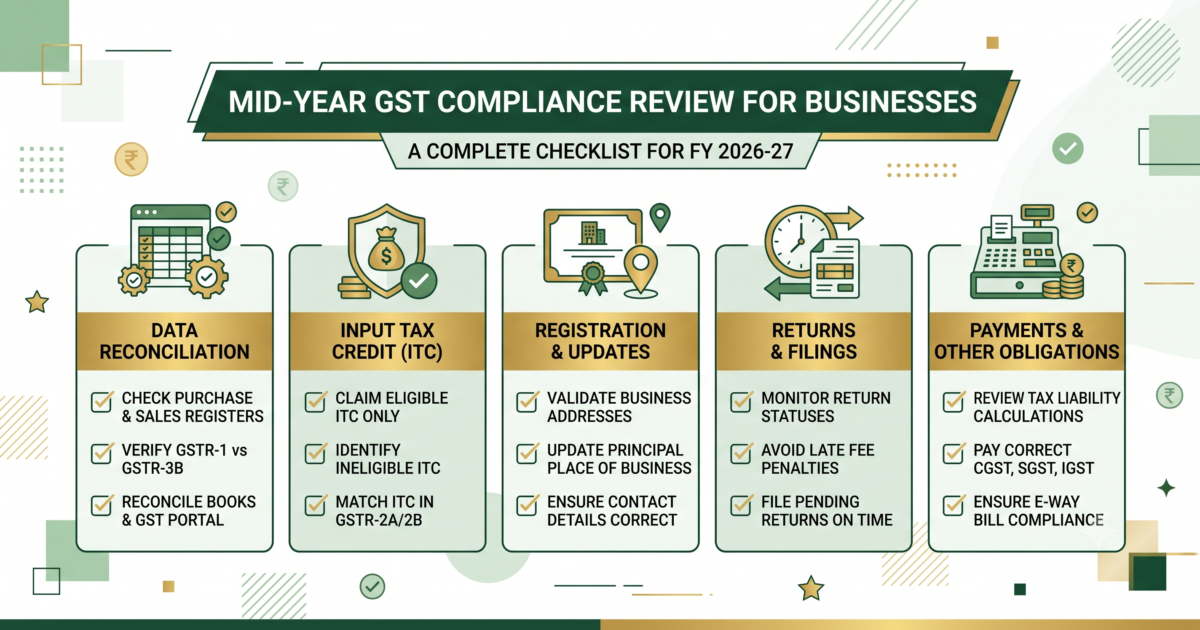
This is why a mid-year GST review – ideally done in July or August, right after Q1 filings settle – matters more than ever. Here’s a complete, practical checklist to work through.
1. Reconcile GSTR-1, GSTR-3B, and Your Books
Start with the basics, because most downstream problems trace back here. Pull your GSTR-1 (outward supplies), GSTR-3B (summary return and tax payment), and your books of accounts for April to June, and check that the numbers actually agree.
Common mismatches worth hunting for:
- Turnover reported in GSTR-1 vs. books. Even small mismatches compound over months and become harder to explain during scrutiny.
- Tax paid in GSTR-3B vs. tax computed from invoices. Rounding errors and manual entry mistakes are common culprits.
- Credit notes and debit notes issued but not properly reflected in the following month’s return, which quietly distorts your net liability.
If you’re reporting a credit note in GSTR-1, don’t just file it and move on – flag it to your customer immediately. A credit note that your customer rejects in the Invoice Management System (IMS) creates an unexpected GSTR-3B liability on your side and derails the reconciliation. Getting ahead of this conversation saves both parties a scramble later.
2. Audit Your Input Tax Credit Against GSTR-2B
ITC has moved from a self-declared claim to a portal-validated entitlement. GSTR-2B is now the single source of truth for what credit you’re allowed to claim – provisional ITC claims based on self-assessment are largely a thing of the past.
Run a supplier-by-supplier check:
- Is every vendor you’re claiming ITC from actually filing their returns on time? One non-filing supplier can cascade into a blocked claim on your side, even if your own invoice and payment are completely in order.
- Are there invoices sitting in your books that never showed up in GSTR-2B? That’s a signal to chase the vendor before the gap becomes a permanent loss of credit.
- Have you used the IMS to accept, reject, or keep pending each inward supply record, rather than letting it default silently?
Building a simple supplier compliance score – even a basic red/amber/green tracker based on how consistently each vendor files on time – pays off enormously here. It lets you flag risky vendors before their non-compliance becomes your blocked credit.
3. Confirm Your E-Invoicing Threshold Still Applies to You
E-invoicing thresholds have been steadily lowered over the past few years, pulling more mid-sized businesses into mandatory compliance. If your aggregate annual turnover crossed the notified threshold at any point in the current or preceding financial years, e-invoicing becomes mandatory – and non-compliant invoices simply aren’t treated as valid for ITC purposes on the recipient’s side.
Mid-year is a good checkpoint to confirm:
- Your AATO calculation is current and includes all GSTINs under the same PAN, not just the entity you’re reviewing.
- Your billing or ERP system is generating Invoice Reference Numbers (IRNs) on the same day as invoice creation – delayed IRN generation creates its own compliance risk under tightened reporting windows.
- If you supply to Special Economic Zones or use Bill-to/Ship-to structures, your systems are ready for the Ship-To GSTIN field, which becomes mandatory in e-Way Bill and IRN APIs from 1st August 2026.
4. Check Whether the New Document Series Is Actually Being Used
Every business is required to start a fresh invoice, debit note, and credit note numbering series from the beginning of each financial year. It sounds trivial, but continuing the previous year’s series is one of the most common and most avoidable errors businesses make.
If your team hasn’t explicitly confirmed this with your billing software, do it now. A mismatched or continued series creates reconciliation headaches in GSTR-1 and can trigger unnecessary scrutiny from the department, purely on a technicality that costs nothing to fix.
5. Revisit Your LUT and Export Documentation
If your business exports goods or services, or supplies to SEZ units without paying IGST, your Letter of Undertaking (LUT) for FY 2026-27 needed to be filed in Form RFD-11 before your very first export invoice of the year. The LUT from FY 2025-26 expired on 31st March 2026 and does not carry forward automatically.
Mid-year is the right time to confirm:
- Your LUT for the current financial year is actually on file – not assumed to be, but verified on the portal.
- No export invoices were raised in the gap between one LUT expiring and the new one being filed, since that creates an unplanned IGST liability that then needs to be recovered as a refund.
- The refund threshold that previously blocked claims below ₹1,000 has been removed, so smaller pending export refunds that you may have written off as not worth pursuing are now recoverable and worth revisiting.
6. Reassess Your Registration Type and Scheme Eligibility
Turnover growth, new product lines, or a shift in your customer base can quietly change which GST scheme fits your business best. A mid-year check should cover:
- Aggregate Annual Turnover recheck. If your AATO has crossed a registration or compliance threshold since the year began, GST obligations that didn’t apply to you in April might apply now.
- QRMP eligibility. Businesses with turnover up to ₹5 crore can file GSTR-1 and GSTR-3B quarterly while paying tax monthly – useful if your compliance bandwidth is stretched, but it needs to be opted into correctly and consistently.
- Composition Scheme suitability. If you’re a small business paying tax at standard rates but genuinely don’t need input tax credit, it’s worth running the numbers on whether composition would reduce both your tax outgo and your compliance load.
- Reverse Charge Mechanism obligations. If you’re receiving services from a Goods Transport Agency that has opted for forward charge, make sure you’re holding a written declaration from them for FY 2026-27. Without it, the reverse charge liability defaults back to you as the recipient.
7. Clear Any Returns Approaching the Time Bar
This is the change with the sharpest teeth in 2026. The GST portal now enforces a hard, non-negotiable statutory limit – returns more than three years past their original due date can no longer be filed at all, permanently, regardless of the reason for the delay.
If your business has any pending GSTR-9 (annual return), GSTR-9C (reconciliation statement), or older monthly returns sitting unfiled for whatever legacy reason treat clearing them as urgent, not routine. Once a return crosses the three-year mark, that filing window closes for good, and with it goes any related ITC claim or corrective option.
8. Prepare a Scrutiny Response Kit – Before You Need One
The department’s cross-referencing has become considerably more automated, which means notices under ASMT-10, ASMT-11, and ASMT-12 are increasingly triggered by system-detected mismatches rather than manual review. Waiting until a notice arrives to start reconciling is the expensive way to do this.
A basic scrutiny-readiness kit should include:
- GSTR-2B vs. books vs. GSTR-3B reconciliations for each month, with a documented explanation for any variance.
- IRN generation logs and e-Way Bill records, organized by month.
- A record of IMS actions taken on each inward supply – accepted, rejected, or pending – with reasons noted for rejections.
Having this ready doesn’t just speed up your response if scrutiny does happen. It’s also the same discipline that catches errors early, before they ever reach a departmental notice.
9. Check ISD Registration If You Operate Across Multiple GSTINs
If your business has a head office or central procurement function that receives input services used across branches registered under different GSTINs but the same PAN, Input Service Distributor (ISD) registration and distribution has become a mandatory mechanism rather than an optional one. A mid-year check should confirm that eligible credit is actually being distributed to the right branches through the correct ISD filings, rather than sitting unclaimed or misallocated at the head office.
10. Review Sector-Specific Rate Changes That Affect You
The broader GST rate rationalisation – moving most goods and services onto a simplified 5%, 18%, and 40% structure – took effect through late 2025 and into 2026, but sector-specific notifications have continued to arrive through the year, covering areas like tobacco and carbonated beverages, digital services classification, and intermediary services for exporters. If your business touches any of these categories, a mid-year check on whether your billing system reflects the current applicable rate is worth the hour it takes – a wrongly charged rate is far cheaper to fix in July than to unwind after three quarters of invoices.
Building This Into a Habit, Not a One-Time Exercise
The businesses that are finding 2026’s GST environment manageable rather than stressful share a common pattern: they’ve turned reconciliation into a monthly discipline rather than a year-end scramble. A monthly ITC control check, clean and current HSN master data, same-day IRN generation, and consistent IMS action-taking add up to far less friction than trying to reconstruct a year’s worth of gaps in March.
If your mid-year review surfaces issues, the good news is that July still leaves you two full quarters to fix them before annual return season. Treat this checklist as the starting point for a habit, not a one-off audit.
Quick FAQ
What happens if I miss the GST return filing deadline entirely for one month? You’ll face a late fee calculated per day of delay (subject to a cap) under both CGST and SGST heads, and interest continues to accrue until the return is filed. If the delay stretches beyond three years from the original due date, the return can no longer be filed at all under the current time-bar rules.
Do I need to file a fresh LUT every year even if nothing has changed in my business? Yes. An LUT is valid only for the financial year it’s filed for and must be renewed before the first export invoice of each new financial year, regardless of whether your business circumstances have changed.
Is e-invoicing mandatory for all businesses? No – it applies only once your aggregate annual turnover crosses the notified threshold. However, that threshold has been lowered over successive years, so it’s worth rechecking your eligibility each year rather than assuming your previous year’s status still applies.
What’s the difference between GSTR-2B and GSTR-2A? GSTR-2A is a dynamic, continuously updated statement of inward supplies based on supplier filings, while GSTR-2B is a static, month-locked statement generated on a fixed date each month. GSTR-2B is now the definitive basis for claiming input tax credit.
This article is for informational purposes only and shouldn’t be treated as legal or tax advice. GST rules are updated frequently please verify current thresholds, forms, and deadlines on the official GST portal or with a qualified tax professional before making compliance decisions.