
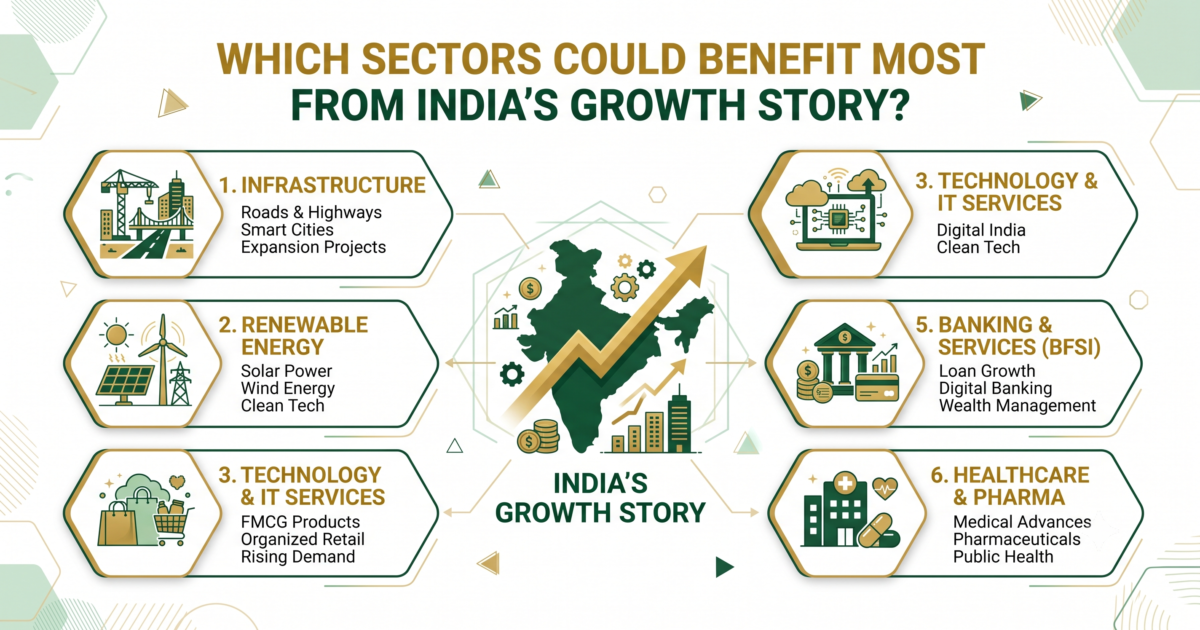
India’s economy grew 8.2% year-on-year in the second quarter of FY 2025-26 one of the strongest quarterly expansions the country has posted in years. That number alone doesn’t tell you much about where to put your money, though. Growth this broad-based touches nearly every sector eventually, but it doesn’t touch them all equally, or at the same time.
Some sectors are riding a wave of government capex that’s been building for three years. Others are catching a rural demand revival that only recently turned real. A few are being reshaped by policy decisions taken just months ago. Here’s a grounded look at where the structural tailwinds actually are and where the excitement outpaces the fundamentals.
The Macro Backdrop, Briefly
A few numbers explain why 2026 feels different from a typical “India growth” year:
- GDP growth of 8.2% in Q2 FY26, with private consumption growing 7.9% in the same quarter, supported by the lowest inflation in a decade and rising disposable incomes.
- Government capital expenditure utilisation rose to 51.8% in the first half of FY26, up sharply from 37.3% a year earlier meaning the capex that was announced is now actually being spent, not just budgeted.
- GST rate rationalisation, rolled out ahead of the festive season, has lowered prices on several categories of consumer goods, directly boosting affordability.
- The RBI held its repo rate at 5.25% through mid-2026 after a cumulative 125 basis points of cuts through 2025, which continues to ease borrowing costs even as the central bank stays watchful on inflation.
Analysts describe this as a “Goldilocks” phase for parts of the economy: borrowing costs falling just as demand accelerates. That combination is exactly why certain sectors are getting disproportionate attention right now.
1. Financial Services (BFSI)
Banks, NBFCs, insurers, and asset managers sit at the intersection of nearly every growth theme in the economy, which is why BFSI has been described as a top alpha sector for 2026. The sector benefited from a strong 2025, with PSU banks surging over 27% year-to-date on improving asset quality and solid credit growth, alongside continued momentum in private banks.
Why it’s positioned well: Falling or stable interest rates typically support credit growth, and India’s still-low credit penetration relative to GDP means there’s genuine structural room to expand not just a cyclical bounce. The shift of India’s capital markets from being FII-dominated toward sustained domestic participation, with monthly SIP inflows running around ₹30,000 crore, also structurally benefits asset managers and brokerages.
What to watch: Asset quality cycles in lending can turn quickly if growth disappoints, and valuations in some pockets of financials have already run ahead of earnings.
2. Rural Consumption and FMCG
This is one of the more underappreciated stories of 2026. Rural FMCG volume growth hit 7.7% in Q2 FY26, sharply outpacing urban growth of 3.7% – a genuine reversal from the urban-led consumption pattern of recent years.
Why it’s positioned well: Three forces are converging here. Stable agricultural output following good monsoons has put more cash in rural hands. GST rationalisation has lowered prices on several everyday goods, directly boosting affordability. And a lower repo rate is easing the EMI burden on entry-level vehicles and appliances – the products most sensitive to rural discretionary spending. FMCG staples and two-wheelers are typically viewed as the most direct beneficiaries of this trend, since two-wheeler sales in particular are considered a lead indicator of rural economic health.
What to watch: Rural consumption is closely tied to monsoon performance and agricultural output, which makes it more weather-dependent than most other sectors on this list.
3. Defence Manufacturing
India’s push toward domestic defence production has moved from policy intent to order-book reality. The sector operates under an Atmanirbhar Bharat mandate requiring domestic procurement, backed by a defence budget of roughly ₹6.2 lakh crore and a target of ₹50,000 crore in defence exports by 2029.
Why it’s positioned well: Order books at major defence public sector units reportedly represent several years of guaranteed revenue – a rare degree of earnings visibility in Indian markets. A “positive list” policy banning imports of hundreds of defence items further channels domestic demand toward local manufacturers almost by regulatory design.
What to watch: This earnings visibility comes at a cost; valuation premiums in defence and capital goods stocks are already elevated, meaning much of the good news may already be priced in.
4. Renewable Energy and Green Transmission
India crossed a genuine milestone in December 2025: 50% of installed power capacity now comes from non-fossil sources, achieved five years ahead of the original 2030 target. That’s a shift in the investment thesis too the theme is moving from pure generation build-out toward transmission, storage, and green hydrogen infrastructure.
Why it’s positioned well: With a target of 500 GW of non-fossil capacity by 2030, and investments in the broader green transition expected to exceed $250 billion by 2030, this is one of the few themes in Indian markets with genuine multi-decade policy backing rather than a short cycle. Rising data centre demand for power, driven by AI and cloud infrastructure buildout, adds an additional, less commonly discussed source of demand for reliable, scalable energy capacity.
What to watch: Execution risk is real in infrastructure-heavy sectors transmission and storage projects often face longer gestation periods and regulatory delays than generation projects did.
5. Information Technology and the AI-Led Pivot
India’s IT services industry faced real headwinds through 2025 – visa uncertainty, tariff concerns, and legitimate questions about whether AI would erode the traditional outsourcing model. The 2026 narrative is more nuanced: the industry is pivoting from a “cost arbitrage” model toward “value arbitrage,” with large-scale AI deployment moving from pilot projects into actual production for global clients.
Why it’s positioned well: Global Capability Centres in India are expanding rapidly, with workforce projections reaching 2.4 million in 2026, increasingly for higher-value engineering and AI-related roles rather than routine back-office work. Tier-2 city expansion into locations like Coimbatore, Indore, and Bhubaneswar is also improving margins by easing the attrition pressure that plagued the sector for years.
What to watch: The core uncertainty hasn’t disappeared – how much of traditional IT services demand AI ultimately displaces versus creates is still an open question the sector is working through in real time, not one that’s been resolved.
6. Infrastructure and Capital Goods
With government capex utilisation climbing to 51.8% in H1 FY26, the multi-year infrastructure push is now translating into actual, bookable revenue for companies rather than remaining a budget-line promise. Gross fixed capital formation grew 7.6% in the same period.
Why it’s positioned well: This is the sector most directly connected to the “execution, not hope” theme analysts are using to describe 2026; years of announced capex are now showing up as order inflows and revenue for construction, capital goods, and infrastructure-linked companies.
What to watch: Government capex cycles can be sensitive to fiscal discipline; India’s fiscal deficit target of 4.4% of GDP this year leaves less room for capex acceleration if revenue collections disappoint.
7. Healthcare, Pharma, and CDMO
India’s pharmaceutical sector long known as the “pharmacy of the world” is entering what industry watchers describe as its next wave, anchored in contract development and manufacturing (CDMO), expected to grow 12-15%+, supported by ecosystem strength across chemicals, intermediates, and active pharmaceutical ingredients.
Why it’s positioned well: India’s MedTech market has historically had 70-80% import dependency, which represents significant headroom for domestic players. Demand drivers include earlier disease onset, a growing chronic care burden, and rising insurance penetration structural factors that hold up regardless of the broader economic cycle, unlike more cyclical sectors on this list.
What to watch: Regulatory approval cycles, particularly for export-oriented pharma companies dealing with international regulators, remain a genuine source of unpredictability.
The Case for Not Picking Just One
It’s worth being direct about something here: there is no single “best” sector for 2026. Banking, consumption, infrastructure, energy, manufacturing, and healthcare are all structurally supported by different pieces of the same broader growth story, and each carries its own cycle and risks. A diversified approach across several of these themes rather than concentrating heavily in one tends to capture India’s broad growth story more reliably than betting on any single sector call proving right.
If you’re investing through mutual funds, sector or thematic index funds now offer relatively low-cost ways to get exposure to a basket of these themes at once, rather than needing to pick individual stocks within each sector.
Quick FAQ
Is it better to invest in individual stocks or sector funds to capture this growth story? Sector or thematic mutual funds and index funds offer diversified exposure within a theme without requiring individual stock selection, which can be a more manageable starting point for most retail investors, though they typically carry a higher expense ratio than broad index funds.
How much of my portfolio should go into these growth sectors? This depends entirely on your individual risk tolerance, time horizon, and existing asset allocation there’s no universal percentage that fits every investor, and it’s worth discussing with a financial advisor if you’re unsure.
Are these sectors likely to keep performing well beyond 2026? Several of the underlying drivers – demographics, infrastructure investment, energy transition, financial inclusion are structural, multi-year trends rather than one-year stories. That said, sector leadership within Indian markets tends to rotate, so no sector should be assumed to outperform indefinitely.
What’s the biggest risk to this overall growth narrative? Global developments remain a real factor; economic slowdowns elsewhere, geopolitical tensions, or sharp commodity price moves can create short-term volatility even when India’s domestic fundamentals stay intact.
This article is for informational purposes only and shouldn’t be treated as investment advice or a recommendation to buy or sell any security. Please do your own research or consult a registered financial advisor before making investment decisions.