
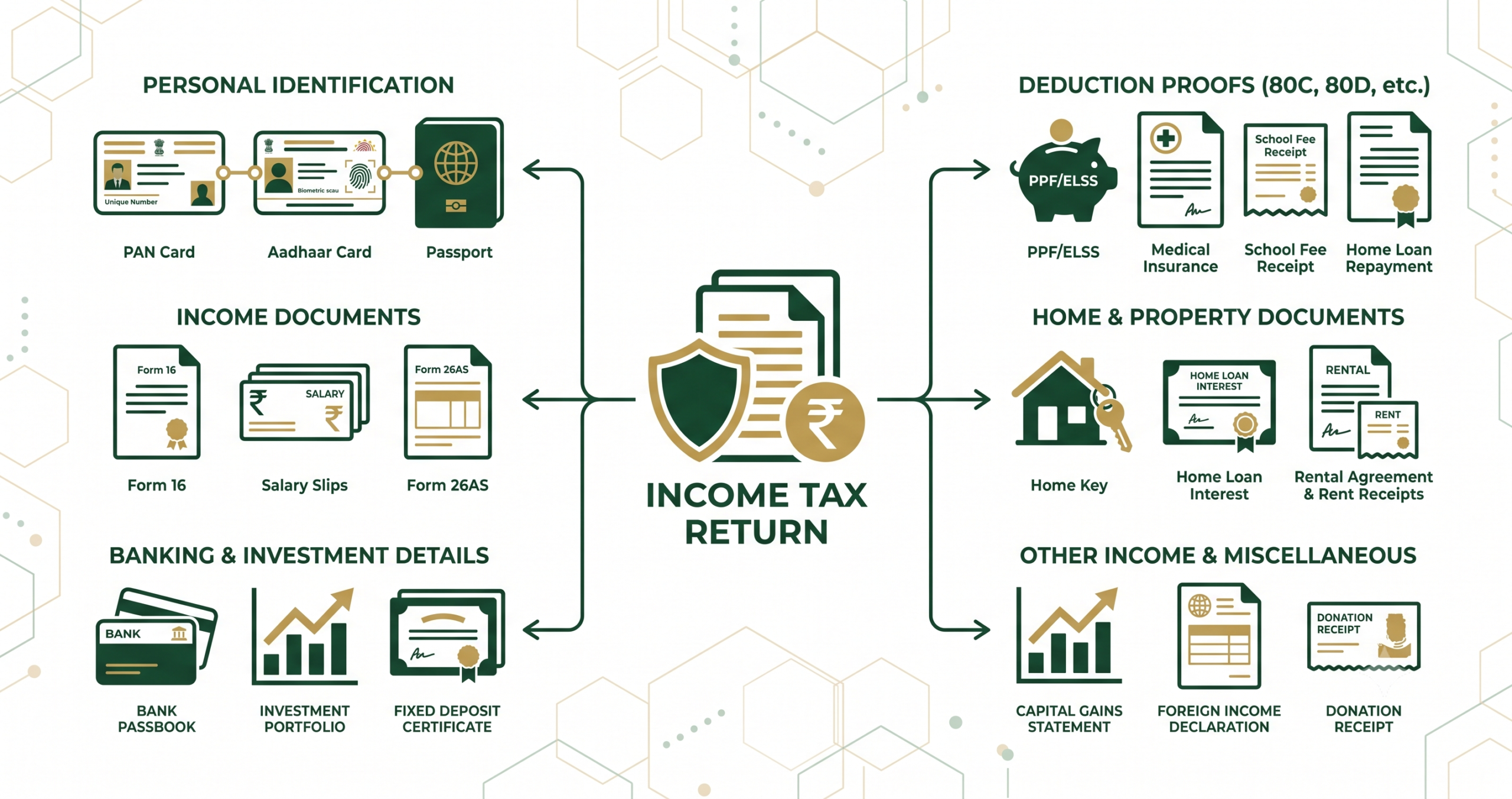
Every July, the same thing happens: taxpayers open the income tax portal, see a mostly pre-filled return, and assume the hard part is done. Then a number doesn’t match, a deduction doesn’t auto-populate, or a small dividend credit shows up that was never accounted for – and the “quick filing” turns into an evening of hunting through email for a TDS certificate.
The tax department’s own data footprint on you is bigger than ever. Your job when filing isn’t really to report income from scratch anymore – it’s to verify that what the department already knows matches what you’re declaring. That only works if you have the right documents in front of you before you start. Here’s the complete list, organised the way you’ll actually need it.
First, Know Which Year You’re Filing For
A quick point of clarity that trips people up every year: when you file your return in July 2026, you’re reporting income earned between April 2025 and March 2026 – that’s Financial Year (FY) 2025-26, filed for Assessment Year (AY) 2026-27. The due date for individuals not requiring an audit is 31st July 2026.
One extra wrinkle this year: India’s new Income Tax Act 2025 came into force from 1st April 2026, but your AY 2026-27 return – since it covers income from before that date – is still governed entirely by the older Income Tax Act, 1961. You don’t need to worry about the new Act’s terminology or section numbers for this filing; that only becomes relevant for income earned from April 2026 onward, which you’ll file next year.
The Core Documents Everyone Needs
Regardless of your income type, these form the foundation of any return:
PAN and Aadhaar. Your Permanent Account Number is the anchor for your entire return, and it must be linked to Aadhaar. You can file using either PAN or Aadhaar in most fields, but PAN remains mandatory for the return itself.
Form 26AS. Your consolidated tax statement showing all TDS deducted, advance tax paid, and self-assessment tax paid against your PAN. Available on the income tax portal, it acts as your tax passbook and is the first thing to cross-check your TDS claims against.
Annual Information Statement (AIS) and Taxpayer Information Summary (TIS). The AIS is a far more detailed statement than Form 26AS, capturing salary, dividends, interest, mutual fund and securities transactions, foreign remittances, and other high-value transactions reported against your PAN. The golden rule here: if the AIS shows an income you haven’t declared – even something as small as a dividend credit – an automated mismatch notice becomes almost certain. Always reconcile your return against the AIS before submitting, not after.
Bank account details. Account number, IFSC code, and bank name for the account where you’d like any refund credited. If you hold multiple accounts, keep statements handy to cross-check interest income and any large or unusual transactions.
Documents for Salaried Individuals
Form 16. Issued by your employer, this remains the single most useful document for a salaried taxpayer. Part A shows TDS deducted and deposited through the year; Part B gives a detailed breakup of your salary, allowances, exemptions, and deductions claimed through your employer. It’s worth noting Form 16 isn’t technically mandatory – you can file without it if you have all the underlying details – but skipping it makes reconciliation considerably harder.
Salary slips. Useful for cross-verifying the figures in Form 16, especially if you switched jobs mid-year and need to consolidate income from two employers.
Rent receipts and rental agreement (if claiming HRA under the old regime). Keep landlord PAN details ready if annual rent exceeds ₹1 lakh.
Interest certificates from banks and post offices for savings accounts, fixed deposits, and recurring deposits – needed to report “income from other sources” accurately, since this is one of the most commonly under-reported income heads.
Documents for Investments and Capital Gains
Capital gains statements. If you sold stocks, mutual funds, or property during the year, get a consolidated capital gains statement from your broker, demat account, or mutual fund RTA (CAMS or KFintech). This should break gains into short-term and long-term, since they’re taxed differently – short-term gains on listed equity and equity funds at 20% and long-term gains above ₹1 lakh at 12.5%, following the Budget 2024 rate revisions.
Property sale documents, if applicable – sale deed, purchase deed, and details of any improvement costs, needed to compute capital gains and claim indexation benefit where eligible.
Virtual digital asset (crypto) statements, if you traded cryptocurrency or other VDAs – these are reported separately under their own schedule and taxed distinctly from other capital assets.
Deduction Proofs – Only If You’re on the Old Regime
This is worth flagging clearly: the new tax regime is the default for AY 2026-27, and it disallows most deductions and exemptions, including Section 80C, 80D, and HRA. If you’re staying on the new regime, you can skip most of the documents in this section entirely – that’s part of what makes it simpler.
If you’re actively opting into the old regime, gather:
- Section 80C proofs – PPF passbook, ELSS statements, life insurance premium receipts, tuition fee receipts, and home loan principal repayment certificate, up to the combined ₹1.5 lakh limit.
- Section 80D proofs – health insurance premium receipts for self, family, and parents.
- Home loan interest certificate from your bank or NBFC, for claiming deduction under Section 24(b).
- Section 80G donation receipts – note that for AY 2026-27, you’re now required to additionally disclose the transaction reference number and IFSC code of the recipient’s bank for each donation claimed, so keep the payment confirmation alongside the receipt.
- Section 80GGC proof, if you’ve donated to a political party – this now requires disclosing the party’s PAN and name as well.
Remember: if you don’t file your return by the due date and were relying on old-regime benefits, you lose the option – a belated return is automatically processed under the new regime, regardless of what you intended.
Documents for Freelancers, Professionals, and Business Owners
If you have income from business or profession, the list expands considerably:
- Profit and Loss statement and Balance Sheet for the financial year.
- Bank statements for all business accounts, to reconcile transactions against your books.
- GST returns, if registered – any mismatch between GST turnover and ITR turnover is a common trigger for scrutiny, so reconcile these before filing.
- Books of accounts, where applicable, especially if you’re subject to tax audit requirements.
- TDS certificates received from clients or customers who deducted tax on payments made to you.
Documents for NRIs
If you’re a Non-Resident Indian filing an Indian return, additionally keep ready:
- NRE and NRO account details and statements, since the two accounts have different tax treatment.
- Residency status proof – passport with travel stamps, or a residency certificate, to establish the number of days spent in India during the year.
- Proof of foreign income, if any portion is taxable in India under a Double Taxation Avoidance Agreement.
A Simple Pre-Filing Checklist
Before you actually start filing, run through this quick sequence:
- Download and review your Form 26AS and AIS side by side.
- Match every TDS entry in Form 26AS with the TDS certificates you’ve received.
- Confirm your tax regime choice – old or new – before entering any deduction details.
- Reconcile bank interest, dividend income, and mutual fund transactions against the AIS.
- Gather deduction proofs only if relevant to your chosen regime.
- Keep everything scanned or photographed and stored together – you generally won’t need to upload documents unless your return is picked for scrutiny, but having them ready saves real stress if it happens.
Quick FAQ
Is Form 16 mandatory to file my ITR? No. Form 16 is not legally mandatory – you can file your return using Form 26AS, AIS, and your own salary records if you have all the necessary details. It simply makes the process considerably easier.
What happens if income shown in my AIS doesn’t match what I report? Mismatches between the AIS and your filed return are a common trigger for automated notices from the tax department. It’s best to reconcile and address discrepancies before filing rather than after, either by including the income or by using the feedback option on the AIS if the entry is genuinely incorrect.
Do I need to submit these documents while filing? No. There’s generally no requirement to upload or submit documents at the time of filing your return. They’re only needed if your return is selected for scrutiny, in which case they can be submitted through the e-proceedings tab on the income tax portal.
What’s the penalty for missing the filing deadline? A belated return attracts a late fee under Section 234F – ₹1,000 if your total income is up to ₹5 lakh, and ₹5,000 otherwise – along with interest on any unpaid tax. If you were planning to use the old tax regime, filing late also means losing that option automatically.
This article is for informational purposes only and shouldn’t be treated as tax advice. Please verify current forms, thresholds, and deadlines on the income tax e-filing portal or consult a qualified tax professional before filing your return.